

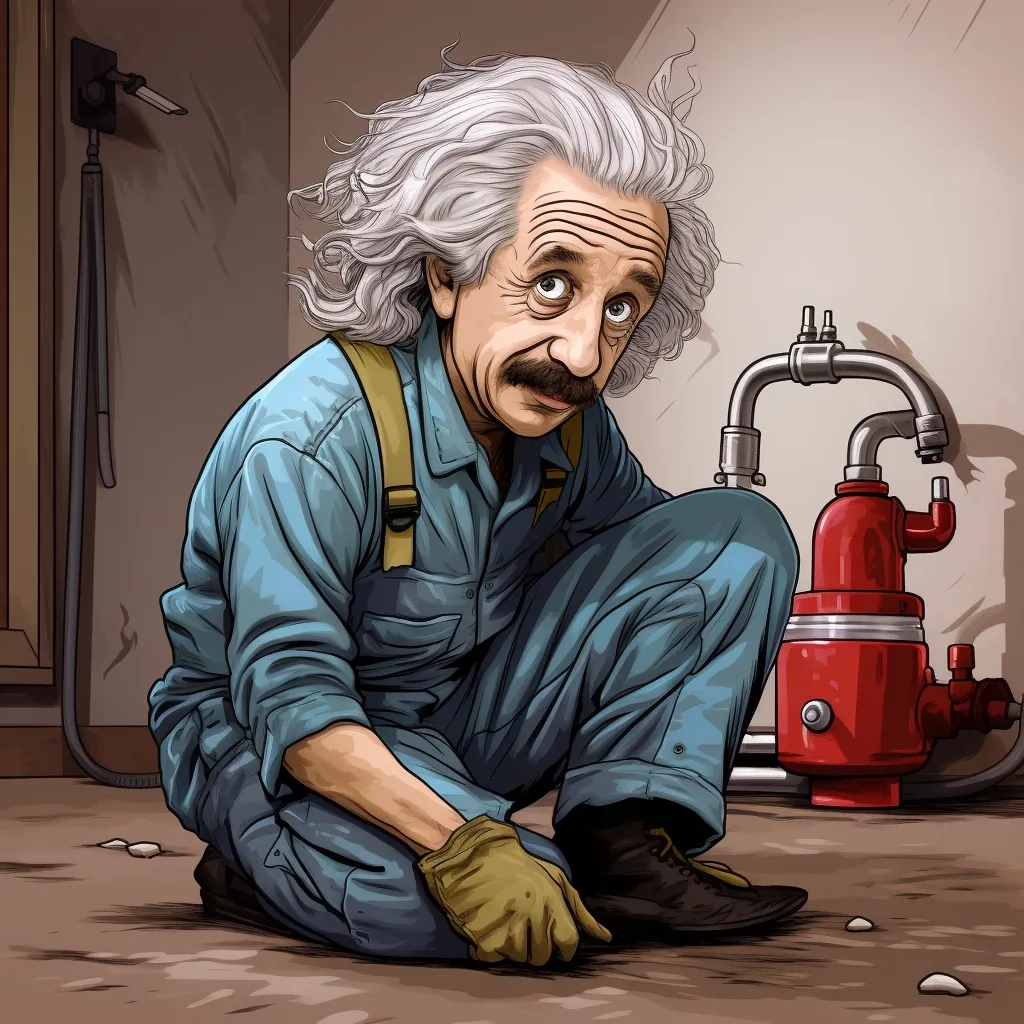
When one thinks of Albert Einstein, the image of a brilliant physicist and the father of modern physics comes to mind. His groundbreaking theories and contributions to science have left an indelible mark on our understanding of the universe. However, there's a lesser-known aspect of Einstein's early life that might surprise you – his fleeting aspiration to become a plumber.
In his youth, long before he became synonymous with E=mc² and the theory of relativity, Einstein was a curious and unconventional thinker. Born in 1879 in Ulm, Germany, he exhibited an insatiable thirst for knowledge from a young age. While he struggled in school due to his rebellious nature and disdain for rote learning, his passion for understanding the world around him was undeniable.
As a teenager, Einstein found himself intrigued by mechanical and technical pursuits. He enjoyed tinkering with mechanical devices and exploring the inner workings of machinery. It was during this time that he developed an interest in plumbing, an interest that might seem unexpected given his later achievements.
Einstein's fascination with plumbing stemmed from his fascination with the way systems functioned. Plumbing, with its complex networks of pipes, valves, and fixtures, presented a real-world puzzle for his inquisitive mind. He often engaged in discussions with his close friends about the intricacies of plumbing systems and how they facilitated the flow of water.
In fact, it's been documented that Einstein once said to a friend, "If I were not a physicist, I would probably be a plumber." This seemingly whimsical statement speaks to his appreciation for the practical applications of plumbing and his belief in the importance of understanding everyday systems.
Einstein's foray into plumbing aspirations wasn't just a passing fancy. He reportedly used plumbing-related analogies in explaining some of his early scientific ideas to friends and colleagues. This unique approach showcased his ability to draw parallels between seemingly disparate concepts – a skill that would later play a role in his groundbreaking work.
So, what changed? How did Einstein transition from contemplating plumbing to revolutionizing physics? The answer lies in his relentless pursuit of knowledge and his determination to explore the fundamental nature of the universe. Einstein's insatiable curiosity led him to delve deeper into theoretical physics, eventually propelling him into the scientific realm that would make him a household name.
While Einstein's plumbing aspirations may not have materialized, they offer a glimpse into the multifaceted nature of his thinking. His willingness to explore unconventional ideas, even if they didn't ultimately define his career, reflects his open-mindedness and creative approach to problem-solving.
In retrospect, Einstein's early interest in plumbing serves as a reminder that even the most renowned figures in history had diverse interests and aspirations. It's a testament to the fact that inspiration can be found in unexpected places, and that the path to greatness is often marked by a willingness to explore various avenues of thought.
So, the next time you turn on your faucet or marvel at the wonders of modern plumbing, take a moment to remember that even the brilliant mind of Albert Einstein once contemplated the mysteries hidden within the flow of water.
In the grand tapestry of his life, plumbing might have been a brief thread, but it's a thread that adds depth to our understanding of a man whose intellectual journey reshaped the way we perceive the universe.
As Einstein himself might say, "The important thing is to never stop questioning, to never lose that childlike sense of wonder." And who knows, perhaps in an alternate reality, we're discussing Einstein the plumber as much as Einstein the physicist.